For the weary soul
So you’re feeling overwhelmed by the world, by all the ways it could be better, and all the ways it feels entirely out of your control.
My friend, you are not alone.
My job as a therapist isn’t to deny painful realities, but to sit with them. To be with people in pain and fear and hopelessness, and explore a way through.
We can’t unthink the wildfires, wars, and staggering injustices. But we can find a way of being able to live a life that doesn’t deny those things, while still being meaningful and connected.
One of my favourite pieces of writing on this is a letter written to a young activist by Clarissa Pinkola Estés in 2001, now published as an essay (link below). In it, Estés says:
“In any dark time, there is a tendency to veer toward fainting over how much is wrong or unmended in the world. Do not focus on that. Do not make yourself ill with overwhelm. There is a tendency too to fall into being weakened by perseverating on what is outside your reach, by what cannot yet be. Do not focus there. That is spending the wind without raising the sails.”
She isn’t suggesting we stop caring; she’s inviting us to focus our care into action.
But faced with overwhelming need, it’s not easy to know where to start - or to feel confident that your contribution will have any meaningful impact.
Changing the story
I recently read a book called Citizens (details below), which suggests that one of the challenges is that we’ve been living in a ‘consumer’ story for so long, which centres the individual, and our individual choices being the only source of our power.
Framed in that way, it’s easy to feel that it’s pointless separating your recycling when billionaires are launching space rockets, or that your single vote doesn’t contain enough power to change a country.
It’s also no surprise that some of our most celebrated tales are of singular heroes who change the world by fighting against unbelievable odds. This is sometimes called the ‘monomyth’. There’s a temptation towards stories like this, a hope that a hero will arise and make the change we long for.
This is much more alluring than the messy, difficult reality that the world’s biggest, systemic problems need all of us - as citizens, not consumers; as communities, not lone heroes. That major change is very rarely sudden, but incremental.
Because the truth is that every small incremental effort - every decimal of a degree the planet is prevented from warming, every person connected to their community, every child who feels safe - does have an impact, does ripple out. Cumulative effort is the point. Just as there are negative tipping points, there are also positive ones.
Estés echoes this:
“It is not given to us to know which acts, or by whom, will cause the critical mass to tip toward an enduring good. What is needed for dramatic change is an accumulation of acts – adding, adding to, adding more, continuing. We know that it does not take “everyone on Earth” to bring justice and peace, but only a small, determined group who will not give up during the first, second, or hundredth gale.”
Another way of putting it, from Ursula Wolfe-Rocca:
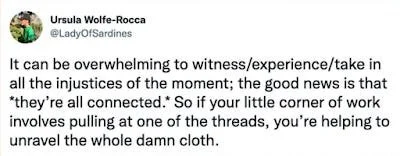
So, when you’re close to overwhelm, the way not to lose heart is to find your people and choose somewhere to start, no matter how small. Do this with friends, neighbours, colleagues. A therapist can help too. You don’t have to do this alone.
A final word from Estés (with emphasis from me):
“One of the most important steps you can take to help calm the storm is to not allow yourself to be taken in a flurry of overwrought emotion or despair – thereby accidentally contributing to the swale and the swirl. Ours is not the task of fixing the entire world all at once, but of stretching out to mend the part of the world that is within our reach.
“Any small, calm thing that one soul can do to help another soul, to assist some portion of this poor suffering world, will help immensely.”
Explore more of these ideas:
The letter to the young activist:
‘Do not lose heart, we were made for these times’ by Clarissa Pinkola EstésOn changing from the ‘consumer story’ to the ‘citizen story’:
Citizens by Jon Alexander and Ariane ConradOn how to care for yourself while caring deeply:
Active Hope by Joanna Macy and Chris JohnstoneOn the power of the monomyth and other narratives:
‘Changing the Story’ by Sarah Woods, Resurgence & Ecologist Magazine